Tutorial: Your first SRM network
In this first tutorial we let three SRM neurons spike.
There are two input neurons with predefined spikes, and they will excite one output neuron.
What do neurons do?
Simply said, neurons send out short peaks of membrane potential, called spikes, and collect spikes from other neurons.
A neuron sends out spikes on it’s axon and it collects the spikes from other neurons using it’s many dendrites. The axon is connected to the dendrites by synapses, which transmit the spike predominantly chemically. Not every synapse transmits the spike equally good (depending on many factors), some strengthen, some weaken the potential. We will call this effect the weight of a synapse.
Later we will see that neural networks can learn. This is because of the different synaptic weights!
Importing the needed libraries
First thing we have to do is to import all the libraries we need:
import numpy as np
from neurons import spiking
Setting up the SRM model
The SRM (Spike-response model) is a model for neurons. New spikes are generated if the incoming current leads the membrane potential to exceed a certain threshold.
model = spiking.SRM(neurons=3, threshold=1, t_current=0.3, t_membrane=20, eta_reset=5)
This sets up a model of 3 neurons. A neuron generates a new spike if it exceeds the threshold of 1mV. The variables t_current, t_membrane are time constants used in the SRM model, and eta_reset resets the membrane potential after a spike (repolarization).
Note
We can say here, that the values are not ‘realistic.’ This is because our SRM implementation assumes a resting potential of 0mV! Real neurons have a resting potential of around -73mV (and a threshold of -54mV, and an action potential of 40mV).
But this should not further disturb us, because we assume that our model linearly shifts those real values. After all, it makes the computations easier if we assume a resting potential of 0mV.
Inter-neural weights
We want to connect our three neurons together like this:
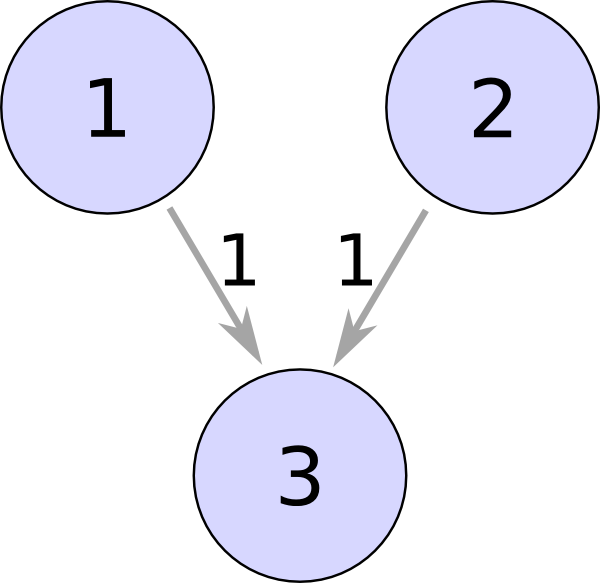
Both, the first and the second neuron, are connected to the third neuron with a weight of 1. Note that the connections are directed. Neuron 1 is connected to Neuron 3 but not vice versa!
We can express this connection in a symmetric matrix: \(w = \begin{pmatrix}0 & 0 & 1 \\0 & 0 & 1 \\0 & 0 & 0\end{pmatrix}\), where the entry \(w_{ij}\) represents the weight that neuron i is connected to neuron j.
Therefore, we define a suitable Numpy array:
weights = np.array([[0, 0, 1.],
                    [0, 0, 1.],
                    [0, 0, 0]])
Note
The weight array should be a float array. So make sure to write at least one float entry (like ‘1.’) or create it using np.array([....], dtype=float).
Preparing a spiketrain
Without any initial spikes, our model would do nothing!
So let’s define some spikes for our neurons:
spiketrain = np.array([[0, 0, 1, 0, 0, 0, 1, 1, 0, 0],
                       [1, 0, 0, 0, 0, 0, 1, 1, 0, 0],
                       [0, 0, 0, 0, 0, 0, 0, 0, 0, 0]], dtype=bool)
This matrix means that the first neuron spikes at times of 2ms, 6ms and 7ms, and that the second neuron spikes at times of 0ms, 6ms and 7ms.
For the third neuron, we didn’t define any spikes at all. We expect that it will spike during the simulation.
Simulate the network
We prepared the SRM neurons, a spiketrain, and the inter-neural weights, so we are ready to simulate the net!
for time in range(10):
    total_potential = model.check_spikes(spiketrain, weights, time)
check_spikes(spiketrain, weights, time) calculates the membrane potential at a time t. It checks if any spikes occurred, and accordingly changes the spiketrain array in-place.
In the for-loop we calculate the membrane potential (and if exceeding the threshold generating new spikes) for every time from 0ms – 9ms.
Enjoy the result
We are nearly finished, now all that we want to do is to enjoy our result:
print("Spiketrain:")
print(spiketrain)
Which gives us:
Spiketrain:
[[0 0 1 0 0 0 1 1 0 0]
 [1 0 0 0 0 0 1 1 0 0]
 [0 0 0 1 0 0 0 0 1 0]]
As we expected, our third neuron spiked (at times 4ms and 9ms), because it collected the spikes of the other two neurons.
Conclusion
As you see it didn’t take much to simulate our first SRM network: just under 10 lines of Python code.
In the next part of the tutorial section we’ll see how we can learn the parameters based on the STDP model.
Sourcecode
Here you can see the whole source code for our little SRM network:
import numpy as np
from neurons import spiking

model = spiking.SRM(neurons=3, threshold=1, t_current=0.3, t_membrane=20, eta_reset=5)

weights = np.array([[0, 0, 1.], [0, 0, 1.], [0, 0, 0]])

spiketrain = np.array([[0, 0, 1, 0, 0, 0, 1, 1, 0, 0],
                       [1, 0, 0, 0, 0, 0, 1, 1, 0, 0],
                       [0, 0, 0, 0, 0, 0, 0, 0, 0, 0]], dtype=bool)

for time in range(10):
    total_potential = model.check_spikes(spiketrain, weights, time)

print("Spiketrain:")
print(spiketrain)
Questions
Q: Why don’t we define the weights at the initialization, but at every call of spiking?
A: Because the weights can change during the simulation (for example by STDP learning). So it is better to pass the current weights at each call of check_spikes().
Q: How do we come up with the parameters for our model?
A: Honestly, we just invented them to fit for this example. Of course, if you want to use the model for real-world applications, you have to choose the parameters more sensibly.